

Just for argument’s sake, let’s compare two players’ stats through their age 33 seasons.
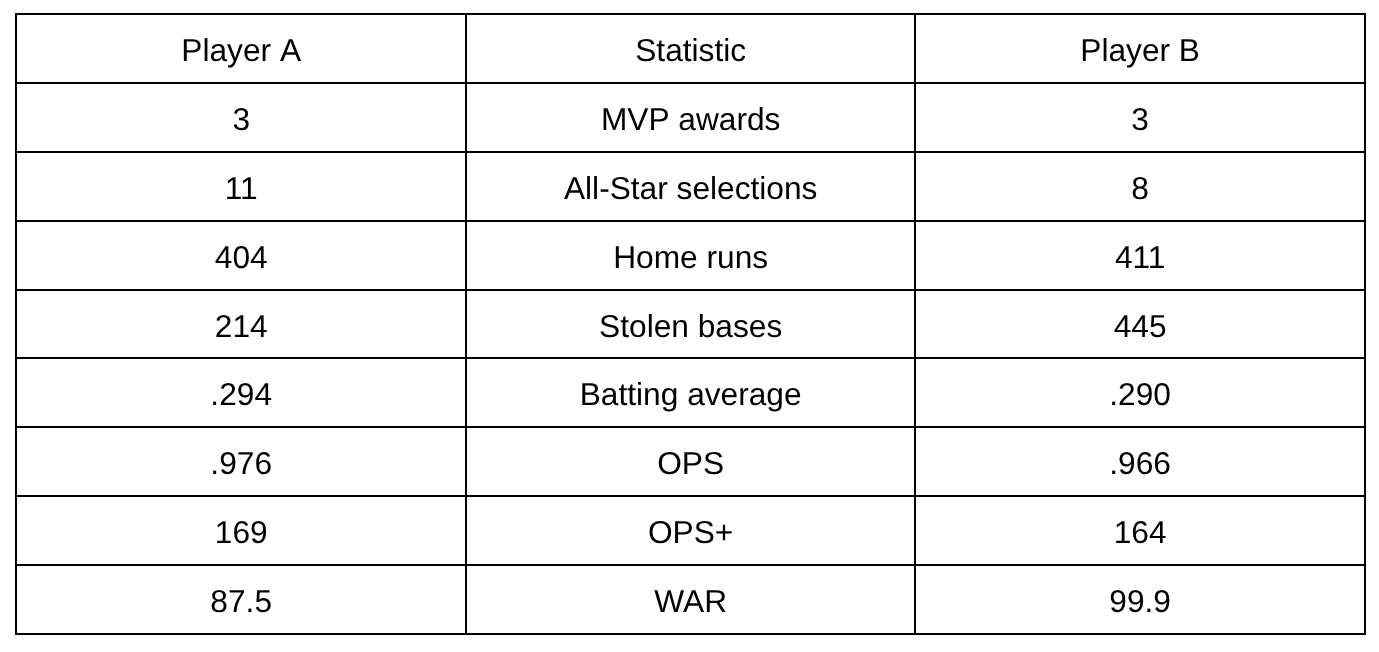
Player A is Mike Trout, undoubtedly a Hall of Fame-caliber player.
Player B is Barry Bonds from 1986-1998.
A few hundred steals (and a few hundred walks) aside, the stats from the early and middle parts of their careers are eerily similar.
If you were to discount or discredit everything Barry Lamar “Sledgehammer” Bonds accomplished during the advanced chemistry phase of his career, he was still a first-ballot, inner-circle Hall of Famer.
Which is something I hope a panel of 16 voters is taking into account when they consider Bonds as part of the Contemporary Era ballot, the results of which will be announced on Sunday. If Barry gets 12 votes, he’s in.
Barry has had his detractors over the years for his surly behavior and connections to the performance-enhancing drugs cloud that enveloped the game in the 1990s and early 2000s.
I just can’t understand why anyone, at this point, still wants to keep Barry out of the Hall of Fame. Not after so many of his less worthy contemporaries, including those who’ve used PEDs themselves, have already been enshrined.
The most egregious enshrinee is Allen H. “Bud” Selig, who worked in car leasing before getting into baseball ownership and eventually, the commissioner’s office. Bud oversaw the game during a time of great change. Interleague. Wild card. Expansion. Salary explosion. That stupid tie in the All-Star Game.
But there was this other thing that he didn’t want to do anything about: performance-enhancing drugs.
Bud was asked repeatedly about PEDs usage in baseball. As he told Bob Nightengale in 1995, “If baseball has a problem, I must say candidly that we were not aware of it. It certainly hasn’t been talked about much. But should we concern ourselves as an industry? I don’t know. Maybe it’s time to bring it up again.”
Bud didn’t, in fact, find the time to bring it up.
For years and years.
By the time he shared his empty insights in that 1995 interview, some of baseball’s biggest stars were already part of an FBI investigation into a steroids ring, and MLB was warned about it but collectively shrugged.
Bud and the rest of the league stuck its collective heads in the sand, ostrich-like, leaving players to make a difficult choice for themselves: to use or not to use.
Players have been considering miracle drugs and improved performance long before the age of Bud, all the way back to the age of “Pud.”
James “Pud” Galvin, a 19th-century pitcher, was baseball’s first known juicer. Pud, in 1889, received injections of a substance obtained from animal testicles, a process known as Brown-Séquard Elixir, meant to improve vitality. No one batted an eye when Pud was enshrined in the Hall of Fame in 1965.
The pharmaceuticals improved across the 1900s. Greenies (amphetamines) helped players perk up and stay on the field. By the later part of the century and early 2000s, anabolic steroids and human growth hormone entered the chat and helped players build muscle.
Barry came into the height of his powers during that anabolic age, and with the help of a burly, shredded physique, set the single-season and all-time home run records.
The Hall of Fame never set parameters for how voters should handle players suspected of using PEDs. But since Barry became a poster child of a scandalous era, the voters wanted to make an example of him. Bonds topped out at 66% of the vote before falling off the ballot.
If there was a hard-line stance about keeping drug users and suspected users out of the hall, so be it. But by now there are dozens of players who used PEDs in the hall.
Some, like the great Hank Aaron, were open about trying PEDs. Willie Mays was accused of having “red juice” in his locker. David Ortiz, a clutch but statistically inferior contemporary of Bonds, failed a drug test but was still elected on the first ballot.
Waves of Barry’s steroids-aided contemporaries have been elected.
And yet, Barry remains on the outside, as he has for the past 12 years. The same goes for pitcher Roger Clemens, who’s also on the ballot for Sunday’s election results.1
It’s great to send a message that performance-enhancing drug use shouldn’t be rewarded. But the time to send that message was during Barry’s career, not retroactively.
Singling out Barry doesn’t have a purpose anymore, not with so many other confirmed, suspected or secretive PEDs users already enshrined.
More than a decade into this charade, the Barry Bonds Hall of Fame discussion is boring. At this point, there really isn’t anything to debate.
Unlike another baseball pariah, Pete Rose, who was banned from baseball for betting on the game and barred from Hall of Fame induction during his lifetime, Barry never broke a cardinal sin.
He was simply too good for too long.
There’s this idea that enshrining Barry would compromise the integrity of the Hall of Fame. Instead, I think the Hall of Fame’s integrity is compromised as long as Barry’s plaque is missing from the wall.
Currently, Barry is above the hall. Every election cycle when a Todd Helton or Scott Rolen gets enshrined, we compare them (unfairly) to this other player stuck in baseball purgatory who was so much better than they were.
Barry’s shadow looms so large over the hall because he’s superior to all but a handful of the players enshrined.
Maybe Ted Williams was better.
Maybe Babe Ruth.
… And that might be it.
There’s a reason why Barry is known as the G.O.A.T.
I’ve spent the past 15 years studying and talking to people about the era in which Barry played. Among the hundreds of people I interviewed are teammates and friends of Barry’s and opposing pitchers who gave up home runs to him.
They all agree that he’s a Hall of Famer. All it will take is 12 votes to confirm what we already know.
This Contemporary Baseball Era player ballot is stacked with worthy players. Gary Sheffield, for example, amassed 509 home runs, walked more than he struck out, nearly won a triple crown, helped carry the Marlins to a world championship in 1997, and had one of the most iconic batting stances to boot. All of the people on the ballot—the others are Dale Murphy, Don Mattingly, Jeff Kent, Carlos Delgado and Fernando Valenzuela—have legitimate HOF cases.
I agree Bonds shouldn't be punished for doing something that wasn't against the rules when he started doing it. Plus, Sheffield "unknowingly" used steriods and was mentioned in both the BALCO scandle and the Mitchell report, so he should be casting stones. I always say that I could take all the steroids, HGH, and whatever else, that has ever been made and might be able to hit 6 homers a season, just when my bat and the ball happened to colide. Bonds still had to have more talent then most major leaguers to do even half of what he did.
As for Rose, I don't agree with people who say that Rose should be in the Hall of Fame because betting on baseball is the same as taking steroids. If it were up to me, and of course it's not, he would never get in. He broke a long standing rule about betting on baseball, a rule that saw people given the same punishment he received. He knew what would happen to him if he were caught while he was doing it. Also, while steriods could affect the outcome of a game, betting on a game, especially from a coach, casts a shadow over every decision made in every game he coached. On top of all that was the fact that Rose kept lying about it. He never bet on sports, ok, he did but never on baseball. Ok, he did but never on my team. Ok, he did but he never bet on them to lose. Ok, but that bet never changed the way I managed. Sure Pete, what ever you say.
My slant: I think Bonds, McGwire, Clemens, Manny Ramirez, even Sosa belong. But I respect now these veterans part of the review committees, current Hall members, who stand their ground and now have a say in it. My hope would be these veterans committees to be larger than 16. And stop rotating people in and out based on the group considered. This is how we have Harold Baines in the Hall. Nice career but ... Expand the ballot and expand the voting base and make it all ex-players. The execs and historians and broadcasters sprinkled in seem like damage control voices but shouldnt hold as much weight as "legit" Hall of Fame members.
This fully loaded class considered today will only have three at best added. From this group at least a half dozen deserve to go in. My heart leans into Valenzuela and Dale Murphy, who I admired stats and all. Garvey should be there. Maury Wills ... finally Hodges made it. Great conversation.
Rose? I am ambivalent.
Shoeless Joe: In.
This is why the Baseball Reliquary's Shrine of the Eternals makes so much sense.
(Exit soapbox)